
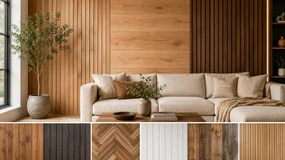
Complete Guide to Wood Wall Paneling 2026: Types, Costs, Install
The best wood wall paneling for your home in 2026 depends on room moisture, acoustic needs, style, and budget. Use paintable MDF (Medium-Density Fiberboard) for value, waterproof WPC (Wood Plastic Composite) or naturally rot-resistant Cedar for bathrooms, and acoustic slat panels where echo control matters.
Choose premium White Oak or Walnut when you want timeless grain and a luxury finish. Always plan for trims, waste, and installation to ensure a seamless project.
Wood paneling has moved far beyond 1970s sheets into refined, architectural elements that add warmth, texture, and performance. Vertical acoustic slat panels are leading because they visually lift ceilings and tame echo in open spaces. This guide helps you compare panel types, species, materials, room-by-room choices, installation, and costs, with practical tips from Total Wood Store, a family-run lumber yard known for quality materials, Redi-Cut sizing, and sustainable sourcing.
Key Takeaways
- Budget for the full project, not just panels: trim and hardware can add 12-18% to materials, and you need a 10-15% waste margin
- Match material to the room: MDF runs about $3.50-$8.00 per sq ft, WPC/PVC about $5.00-$11.00 per sq ft, and acoustic slats about $7.50-$22.00 per sq ft
- For acoustics, premium slat panels reach NRC (Noise Reduction Coefficient) 0.50-0.85, and 0.85 means roughly 85% of speech-range sound is absorbed
Why Wood Wall Paneling Dominates Interior Design in 2026
Today’s paneling is precision milled, thoughtfully finished, and designed to showcase grain, not hide it. It feels nothing like the dark, glossy sheets of the 1970s. Matte and satin finishes protect without masking texture, which aligns with 2026’s focus on warmer, quieter interiors.
Acoustic performance is a major driver. Slatted panels and felt-backed systems help calm echo in open plans and hard-surface rooms, improving comfort and speech clarity. Biophilic design also favors natural materials because real grain adds warmth and organic rhythm that paint and wallpaper cannot replicate at scale .
Main Types of Wood Paneling
You have classic joinery styles and modern systems that add texture and function. Choose based on moisture, profile depth, and installation path. Vertical slat panels, often veneer strips over felt, dominate for their clean rhythm and acoustic gains.
Shiplap boards overlap at a rabbet to create crisp shadow lines and straightforward alignment, great for casual or coastal aesthetics. Tongue and groove, where boards interlock, yields a seamless, stable surface suited to walls and ceilings. For a reversible profile, Total Wood Store’s Clear Pine Double Bead gives you center-and-edge bead on one side and a V-groove on the other for flexible styling.
Quick comparison of popular panel styles
| Type | Typical install method | Best applications | Notes |
|---|---|---|---|
| Shiplap | Nail to studs or furring; align rabbets | Coastal, farmhouse, hall wainscoting | Clean lines, simple layout |
| Tongue & Groove | Blind-nail through tongue | Walls, ceilings, cabins, modern minimal | Tight seams, stable surface |
| Beadboard | Nail panels or strips; cap with trim | Baths, mudrooms, cottage style | Fine vertical texture; easy to paint |
| Board & Batten | Nail boards, overlay battens | Architectural interest, tall walls | Strong shadow play, grid flexibility |
| Acoustic Slat | Screw or adhere felt-backed panels | Living rooms, offices, theaters | Sound dampening and vertical rhythm |
| 3D/Fluted | Adhesive or brad nails; measure carefully | Feature walls, islands, headboards | High-impact texture and depth |
Choosing the Right Wood Species
Match species to the mood and environment. White Oak leads for its straight grain, pale tan color, and cellular structure that limits water movement, which supports stability in fluctuating humidity. Walnut delivers rich chocolate tones and complex figure for formal spaces and executive looks.
Cedar stands out where moisture or insects are concerns. Western Red and Eastern Aromatic Cedar have natural oils that resist rot and pests, which is why they shine in baths, closets, and utility rooms. For high-wear zones, dense species like Hickory or Ash handle dings and traffic well.
Room-aligned species picks
- Living rooms and offices: White Oak for light, Scandinavian palettes; Walnut for depth and contrast
- Bathrooms and laundry zones: Western Red Cedar T&G or channel pattern in protected areas with good ventilation
- Closets: Eastern Aromatic Cedar for its scent and pest resistance
- High-traffic halls: Ash or Hickory veneer panels for impact resistance
Materials Beyond Solid Wood
Engineered and composite solutions balance performance with cost. MDF (Medium-Density Fiberboard) is the standard for paint-grade grids and fluted profiles, with smooth surfaces and stable sizing at a budget price of roughly $3.50-$8.00 per sq ft for materials. Wood veneer panels bond real hardwood faces to MDF or plywood cores to deliver a premium look with better budget control.
In wet zones, WPC (Wood Plastic Composite) and PVC panels are 100% waterproof, often used to mimic slatted or fluted looks in bathrooms and kitchens, and they run about $5.00-$11.00 per sq ft for materials. Acoustic slat panels, typically veneer over MDF slats on felt, cost about $7.50-$22.00 per sq ft for materials.
Material costs and installed estimates
| Material | Material cost/sq ft | Installed estimate/sq ft | Notes |
|---|---|---|---|
| MDF (paint-grade) | $3.50-$8.00 | $7.50-$16.00 | Smooth, budget friendly |
| WPC/PVC | $5.00-$11.00 | $9.00-$19.00 | 100% waterproof for wet zones |
| Acoustic slat | $7.50-$22.00 | $12.50-$25.00+ | Felt-backed slats for acoustics |
| Solid hardwood | $15.00-$40.00+ | $23.00-$50.00+ | Luxury grain, refinishable |
Selecting Paneling by Room
Tie performance to the room’s demands. In living rooms, acoustic slat panels reduce TV echo and add vertical rhythm. Fluted profiles create depth behind furniture groupings. For bedrooms, calm tones in White Oak veneer, vertical shiplap, or headboard-height fluted MDF add softness and reduce reverberation.
Kitchens and dining areas benefit from durable, easy-clean surfaces and moisture-aware choices near sinks. Bathroom walls behind vanities or on feature zones should be WPC (Wood Plastic Composite) or naturally rot-resistant Cedar, with good ventilation and careful sealing where needed. Home offices and meeting rooms gain clarity on calls with felt-backed slats that absorb speech-range echo.
Practical room picks
- Living room feature wall: Acoustic slat veneer on felt for echo control and height effect
- Bedroom headboard wall: Fluted MDF, paint-grade, or quiet White Oak veneer for warmth
- Kitchen island wrap: Fluted wood for texture against stone counters
- Bathroom accent: 100% waterproof WPC slat panels for spa-like looks
- Hallways: Painted MDF wainscoting or Ash veneer for scuff resistance
Top Wood Paneling Trends in 2026
Vertical lines lead the year because they draw eyes up and help small spaces feel taller. Designers are also color-drenching fluted and shaker MDF in creamy taupes, moody greens, and soft blacks to deliver architecture and color in one move.
Seamless integrations like hidden doors inside slat walls, wood-wrapped columns, and floor-to-wall continuity are becoming standard, turning structure into focal points. For finishes, light oaks support Scandinavian minimalism, while walnut fluted panels add drama behind art and lighting.
Wood Paneling Installation Methods
Plan by substrate, pattern, and fastening. Many slat and veneer panels install quickly with construction adhesive or peel-and-stick backing for DIYers. Tongue and groove is typically blind-nailed through the tongue into studs for a clean face.
Acclimate real wood and wood-core panels to room temperature and humidity before install to limit gaps or buckling, especially on large spans. Complex 3D mosaics, raised wainscot, or full-height wraparounds are best left to pros who can handle out-of-plumb walls and electrical cutouts cleanly.
Fastening methods and tips
- Adhesive set: Press felt-backed acoustic panels with a high-bond adhesive or use concealed screws through felt to studs so fasteners disappear
- Mechanical set: Blind-nail T&G through the tongue; pin fluted MDF with brads and adhesive for a flush surface
- When to hire: Intricate layouts or rooms with multiple corners and penetrations benefit from professional carpentry
Wood Paneling Costs in 2026
Budget by material, labor, waste, and accessories. Typical material costs run about $3.50-$8.00 per sq ft for MDF (Medium-Density Fiberboard), $5.00-$11.00 for WPC (Wood Plastic Composite)/PVC, $7.50-$22.00 for acoustic slats, and $15.00-$40.00+ for solid hardwood. Professional installation adds roughly $3-$10 per sq ft for flat walls, and can reach $8-$15+ for complex patterns.
Do not forget the extras. Trims, caps, corners, and hardware often add 12-18% to the base material subtotal, and a 10-15% waste allowance protects you from off-cuts and errors.
Budgeting line items to plan
| Item | Typical range | Source |
|---|---|---|
| Standard labor add | +$3-$10 per sq ft | |
| Complex pattern labor | +$8-$15+ per sq ft | |
| Accessories, trims, hardware | 12-18% of materials | |
| Waste margin | 10-15% of sq ft | |
| Acoustic slat material | $7.50-$22.00 per sq ft |
Acoustic Benefits of Wood Panels
Wood reduces flutter and harsh reflections. Slatted systems scatter highs at the wood face and let sound pass into a dense felt layer that converts acoustic energy into trace heat inside the fibers. Premium panels reach NRC (Noise Reduction Coefficient) 0.50-0.85, a strong result for speech and media rooms.
An NRC of 0.85 means 85% of mid to high frequency energy, roughly 300 Hz to 3 kHz, is absorbed, which is the range where human speech lives. Select felt-backed slats for home theaters, media walls, and offices that need clearer calls.
Sustainability of Wood Wall Paneling
Look for FSC (Forest Stewardship Council) certification to ensure responsible forestry that protects biodiversity and communities. Solid wood and quality veneers often have lower embodied energy than petroleum-based wall coverings, and they can last decades with refinish potential.
Many acoustic panels use recycled PET felt and E0 MDF cores to limit VOCs for indoor air quality. Total Wood Store prioritizes sustainably sourced species and trusted mills, pairing e-commerce convenience with lumberyard-level standards.
Long-Term Maintenance for Wood Panels
Proper maintenance extends the life and beauty of wood wall panels. Follow these best practices:
- Dusting: Use a microfiber cloth or a vacuum with a soft-brush attachment to gently dust grooves and slats from top to bottom.
- Deep Cleaning: For more thorough cleaning, use a nearly dry sponge with warm water and mild dish soap. Wipe the surface gently and dry immediately to avoid water damage.
- Polishing: Apply a light polish, such as lemon oil, twice a year to maintain luster and surface hydration.
- Moisture Protection: In higher moisture or exterior-adjacent zones using Cedar, apply a suitable preservative or sealer to maintain longevity in demanding conditions.
- Avoid: Do not use abrasives, steel wool, or harsh solvents, as these can damage the finish.
Wood Paneling vs Alternatives: Performance Comparison
Wood, MDF (Medium-Density Fiberboard), and WPC (Wood Plastic Composite) act like architectural armor in high-traffic areas. They resist scuffs and hide minor marks better than paint or wallpaper, and can be touched up or refinished in place.
On value, a veneer acoustic panel at $18 per sq ft that lasts 20 years costs about $0.90 per sq ft per year, which often beats the replacement cycle of basic wall coverings. Well-executed wood paneling is widely recognized as a premium upgrade that can increase property appeal and resale.
Sourcing Quality Wood Panels
Vet the supplier as carefully as the product. Look for clear grading like A-4 faces on veneers, transparent species sourcing, and reliable substrates that will not telegraph defects. Total Wood Store bridges e-commerce ease with a multi-generational lumber yard’s standards, and staff hand-select in-stock orders before shipping.
DIY projects are simpler with Redi-Cut options that avoid ripping 4x8 sheets at home. Total Wood Store offers premium species in practical sizes and thicknesses for efficient builds.
Total Wood Store Redi-Cut options
| Species | Common sizes | Thicknesses | Link |
|---|---|---|---|
| White Oak Plywood | 12"x48", 24"x24" | 1/4", 1/2", 3/4" | View |
| Hickory Plywood | 12"x48", 24"x24" | 1/4", 1/2", 3/4" | View |
| Australian Red Cedar Plywood | 12"x48", 24"x24" | 1/4", 1/2", 3/4" | View |
| Aromatic Cedar Paneling | Redi-Cut lengths | T&G profiles | View |
Frequently Asked Questions About Wood Wall Paneling
- Is wood paneling still in style in 2026? Yes. Natural warmth, texture, and acoustic function make it a durable design choice, not a fad.
- Can wood paneling be used in bathrooms? Yes, if you choose the right material. Use 100% waterproof WPC (Wood Plastic Composite) or naturally rot-resistant Cedar with proper ventilation.
- How difficult is DIY installation? Many fluted MDF (Medium-Density Fiberboard) and acoustic slat systems are DIY friendly with adhesives and basic tools. Complex raised panels and 3D mosaics are better left to pros.
- What is the best budget option? Paint-grade MDF, about $3.50-$8.00 per sq ft for materials, is the go-to for value.
- Do wood panels increase home value? Quality paneling is a premium upgrade that can raise buyer appeal and resale.
- Can panels be painted or stained after installation? Paintable MDF can be finished in place. Real wood veneer or solid panels can often be re-finished with care and proper prep.
Getting Started With Your Wood Paneling Project
Order physical samples to confirm color and grain in your lighting, then measure carefully. Multiply your square footage by 1.10 to 1.15 to cover mandatory waste, and earmark 12-18% of materials for trims, caps, and adhesives. Acclimate wood-based panels for several days in the install room before fastening.
Need help translating drawings into a cut list or choosing the right species for your space? Total Wood Store’s team can help you dial in materials, Redi-Cut sizes, and trims to reduce on-site cutting and waste.
Conclusion
Modern wood wall paneling blends beauty with performance. Use MDF (Medium-Density Fiberboard) when you want the best paint-grade value, WPC (Wood Plastic Composite) or Cedar where humidity is high, and acoustic slat panels to tame echo and visually lift a room. Plan for 10-15% waste and 12-18% in trims so your install goes smoothly and your budget stays on track. If you want expert help with species, acoustics, or Redi-Cut sizing, the team at Total Wood Store can translate your vision into a precise materials list. Explore Redi-Cut plywood, Cedar T&G, and more, then request samples and a custom quote to get started today.
References
- How Much Does the Wall Panel Cost?
- The Complete Guide to Wood Wall Paneling: Trends, Installation, Costs in 2026
- Cost to Panel a Wall
- How Much Do Wall Panels Cost? 2026 Price Guide
- Acoustic Slat Wood Wall Panels
- GIVIMO Wood Slat Acoustic Wall Panels
- How to Budget for a Full Room Wood Panel Renovation
- Why Wood Paneling for Walls Is Trending in 2026
- White Oak Plywood Redi-Cuts
- Clear Pine 1x6 Double Bead Paneling