Mahogany Lattice Panels: A Premium Choice for Privacy, Outdoor Living, and Architectural Design
When choosing lattice for a deck, porch, privacy screen, garden structure, or architectural feature, it's easy to assume that all lattice panels are essentially the same. They aren't.
Lattice panels are available in materials ranging from inexpensive vinyl and pressure-treated lumber to cedar and premium hardwoods. While each has its place, Mahogany lattice panels offer a distinctive combination of appearance, strength, stability, and durability that makes them particularly well suited for high-end residential and architectural projects.
If you're considering Mahogany lattice, here's how it compares with other common options and why the additional investment can make sense.
What Is Mahogany Lattice?
Mahogany lattice is constructed from real Mahogany wood rather than vinyl, plastic, composite material, or inexpensive softwood.
Premium Mahogany lattice panels use precisely cut wood laths arranged to create a consistent architectural pattern. Depending on the design, the spacing can provide anything from a decorative accent to substantial visual screening and privacy.
The natural characteristics of Mahogany make it particularly attractive for lattice applications. Mahogany is valued by woodworkers and builders for its rich appearance, relatively straight grain, dimensional stability, workability, and ability to perform well in demanding applications.
Unlike synthetic lattice, every Mahogany panel has the natural grain and subtle color variation of real wood.
- The Appearance of Real Mahogany
Appearance is one of the biggest reasons to choose Mahogany lattice.
Mahogany typically has warm reddish-brown to medium-brown coloring with an attractive natural grain. As a result, lattice made from Mahogany can look more like an intentional architectural feature than a utility product used simply to cover an opening.
This makes Mahogany lattice particularly appropriate for:
- Premium decks and porches
- Outdoor kitchens and living spaces
- Pergolas and gazebos
- Privacy screens
- Garden structures
- Pool and patio areas
- Custom homes
- Historic and traditional architecture
- High-end remodeling projects
- Commercial and hospitality properties
The visual difference becomes especially noticeable when lattice is installed next to quality hardwood decking, exterior millwork, natural siding, or other architectural wood elements.
- Mahogany Offers Excellent Durability
Exterior lattice has to withstand considerably more than many homeowners realize.
Depending on the installation, panels may be exposed to sunlight, moisture, temperature fluctuations, wind, insects, and seasonal weather changes.
Mahogany has a long history of use in applications where durability and dimensional stability are important. With appropriate installation, finishing, and maintenance, Mahogany is an excellent material for exterior architectural woodwork.
This can make it an attractive alternative to lower-cost softwood lattice where longevity and appearance are priorities.
- Better Dimensional Stability
Wood naturally expands and contracts as environmental conditions change, but some species are more dimensionally stable than others.
Mahogany is known for relatively good dimensional stability. That's an important characteristic for lattice because a panel consists of numerous narrow wood laths connected at regular intervals. Excessive movement can affect the appearance and integrity of a lattice panel over time.
Quality Mahogany helps provide a stable foundation for this type of construction. Proper installation remains important. Exterior wood panels should always be installed with appropriate allowances for movement and according to the manufacturer's recommendations.
- Mahogany Lattice vs. Cedar Lattice
Cedar is one of the most popular materials for premium wood lattice, and for good reason.
It is attractive, relatively lightweight, naturally resistant to decay, and commonly used for exterior projects.
For many applications, cedar lattice is an excellent choice.
Mahogany, however, offers a different aesthetic. Its deeper coloring and hardwood appearance can provide a more substantial, furniture-like architectural character.
Mahogany may be the better choice when the surrounding project already incorporates hardwoods or when appearance is a major design consideration.
Choose Cedar when: you want an attractive natural wood lattice at a more economical price.
Choose Mahogany when: you want a premium hardwood appearance and the lattice will be a visible part of the project's architecture.
Neither material is universally "better." The right choice depends on the application, design, budget, and desired appearance.
- Mahogany Lattice vs. Pressure-Treated Wood
Pressure-treated lattice is widely available and usually one of the least expensive wood options.
Its primary advantage is cost.
For utility applications—such as screening the underside of a deck where appearance isn't particularly important—pressure-treated lattice may be perfectly adequate.
Mahogany occupies a very different category.
Premium Mahogany lattice typically provides more refined milling, a more attractive natural grain, and a finished appearance appropriate for locations where the lattice itself is part of the design.
The difference is similar to choosing between standard construction lumber and architectural hardwood millwork. Both can perform a function, but they are intended for different types of projects.
- Mahogany Lattice vs. Vinyl Lattice
Search for lattice panels online and you'll find a large number of inexpensive vinyl products.
Vinyl has some genuine advantages. It doesn't require painting or staining, isn't susceptible to wood decay, and is generally easy to maintain.
But vinyl does not provide the appearance or feel of natural hardwood.
This distinction can become especially important on a home featuring natural wood decking, siding, trim, columns, or other architectural details.
There is also an important shopping distinction to understand:
A product described as "Mahogany," "Walnut," or "Cedar" colored isn't necessarily made from that species of wood.
Many inexpensive lattice products use wood-inspired color names while actually being manufactured from vinyl or plastic.
If you specifically want real Mahogany, check the product's material specifications rather than relying solely on the color or product name.
- Mahogany Lattice vs. Composite Lattice
Composite materials provide another alternative to natural wood.
Like vinyl, composite lattice can offer relatively low maintenance and consistent appearance. It can be a practical choice for homeowners who prioritize ease of maintenance.
Natural Mahogany has a different appeal.
Real wood has variations in grain, tone, and texture that manufactured materials attempt to reproduce but cannot duplicate exactly. Mahogany can also be incorporated naturally into projects featuring other premium wood products.
The choice ultimately comes down to priorities.
If minimal maintenance is your primary concern, a synthetic material deserves consideration.
If natural wood appearance and architectural character are more important, Mahogany becomes much more compelling.
- Privacy Lattice Can Provide More Than Decoration
Traditional lattice often has relatively large openings. That's useful for decorative applications, climbing plants, and deck skirting, but it may not provide much privacy.
Premium privacy lattice uses wider laths and/or tighter spacing to reduce visibility through the panel while maintaining the distinctive appearance of lattice.
This makes Mahogany privacy lattice particularly useful for creating:
- Patio privacy screens
- Outdoor shower enclosures
- Equipment screens
- Pool-area screening
- Outdoor dining spaces
- Deck privacy walls
- Decorative property screens
- Pergola side panels
Instead of constructing a completely solid wall, lattice allows designers to create visual separation while retaining a lighter architectural appearance.
- Mahogany Can Be Finished to Complement the Project
Another advantage of real wood is the ability to choose an appropriate finish.
Depending on the specific Mahogany product and application, a suitable exterior finish can help preserve and highlight the wood's natural color and grain.
Alternatively, some homeowners prefer allowing exterior hardwood to weather naturally.
Finishing requirements vary according to the specific wood, exposure, climate, and desired appearance, so always follow the lattice manufacturer's recommendations and the instructions supplied by the finish manufacturer.
- Premium Lattice Can Become an Architectural Feature
One of the best reasons to consider Mahogany is that lattice doesn't have to be something you try to hide.
An inexpensive lattice panel is often treated as a functional building material. It's installed beneath a deck or around equipment because something needs to be screened.
Premium Mahogany lattice can be approached differently.
It can become part of the architecture.
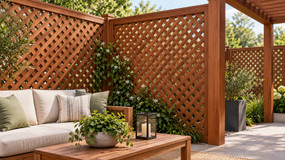
Consider using Mahogany lattice to create a framed privacy wall around a patio, decorative panels beneath a premium hardwood deck, screening around an outdoor kitchen, or an architectural backdrop for landscaping.
When properly designed and installed, the lattice contributes to the appearance of the project rather than simply concealing something behind it.
Is Mahogany Lattice Worth the Additional Cost?
Mahogany lattice costs considerably more than basic pressure-treated or vinyl lattice, so it isn't necessary for every project.
For an inconspicuous utility application, an inexpensive lattice panel may make more sense.
But material cost should be considered in relation to the overall project.
If you're investing in premium decking, professional landscaping, an outdoor kitchen, custom exterior millwork, or a high-end renovation, saving money by installing inexpensive plastic or construction-grade lattice in a highly visible location can undermine the finished appearance.
Mahogany lattice makes the most sense when the lattice itself is an important part of the design.
Comparing Common Lattice Materials
|
Material |
Appearance |
Durability |
Maintenance |
Relative Cost |
Best Use |
|
Pressure-Treated Wood |
Basic |
Good when properly maintained |
Moderate |
$ |
Utility applications and deck skirting |
|
Cedar |
Natural, attractive |
Very Good |
Moderate |
$$ |
Decks, gardens and exterior projects |
|
Vinyl |
Consistent/synthetic |
Very Good |
Low |
$–$$ |
Low-maintenance applications |
|
Composite |
Consistent |
Very Good |
Low |
$$–$$$ |
Low-maintenance architectural applications |
|
Mahogany |
Premium natural hardwood |
Excellent with proper care |
Moderate |
$$$ |
Premium architectural and highly visible applications |
Shop Real Mahogany Lattice Panels Online
For projects where appearance matters as much as function, real Mahogany lattice provides an alternative to ordinary pressure-treated, vinyl, and composite panels.
Total Wood Store offers premium Mahogany lattice panels manufactured from real wood for privacy screening, decks, porches, outdoor living areas, garden structures, and architectural applications.
When comparing prices online, remember to compare the actual material, panel dimensions, lath thickness, spacing, construction quality, and grade. A $50 vinyl panel with a "Mahogany" color isn't equivalent to a premium lattice panel manufactured from real Mahogany hardwood.
For the right project, Mahogany lattice isn't simply a screen—it's part of the finished architecture.