
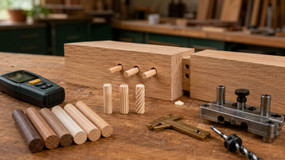
Start with the load and joint style, then match species, size, and surface profile. Use hardwoods like Maple or Oak for structural joinery, follow the 1/3 to 1/2 diameter-to-thickness rule, and leave a 1/16 inch glue relief in blind holes to prevent hydraulic blowout. Control moisture and grain, and choose fluted or spiral pins in enclosed joints for clean glue flow.
At Total Wood Store, we have spent decades helping builders and DIYers pick the right dowels. This guide consolidates shop-proven practices with research-backed specs. You will see how species density, moisture, and grain direction influence strength, why a simple sizing ratio prevents failure, and where fluted or spiral grooves outperform smooth pins in real assemblies. We also include a quick decision framework and application examples, plus direct links to our Maple, Oak, Hickory, and other dowel stock for fast ordering.
Key Takeaways
- Hard Maple’s 1,450 lbf Janka hardness and 15,800 psi MOR signal high load capacity for structural joints, supported by Hard Maple Data; White Oak’s 0.75 specific gravity supports demanding builds, as shown in White Oak SG.
- Size dowels to roughly 1/3 to 1/2 of the board thickness, and keep face-board hole depth under 75% with a 1/16 inch glue relief, following Dowel Sizing Rules.
- Lowering moisture content (MC) below fiber saturation increases compressive strength about 4% to 6% per 1% MC drop, according to the Moisture-Strength Link.
Understanding Wooden Dowel Fundamentals
Wooden dowels are cylindrical rods used to align parts, add shear strength to joints, and serve as structural or decorative elements. In a glued joint, a dowel increases the effective contact area inside the hole and shares stress between members.
With PVA glue, wood fibers absorb moisture and swell slightly, tightening the fit while the adhesive cures. In practice, overall performance depends on four levers: species, geometry, surface profile, and conditioning environment.
Key terms you will see: diameter and length, grain orientation along the dowel’s axis, surface profile types like smooth, fluted, or spiral, and chamfered tips that ease insertion. This guide follows a simple framework, decide the application and load, choose species, calculate diameter and length, select surface profile, confirm moisture and hole prep.
Primary uses
- Joinery: cabinet frames, chairs, table aprons, casework alignment and reinforcement.
- Structural and utility: closet rods, fixtures, jigs.
- Decorative: visible pegs, accents, caps.
- Culinary and craft: cake supports and toys using appropriate, untreated hardwoods.
Impact of Wood Species on Performance
Density and fiber structure drive embedment and shear capacity. Hard Maple delivers high hardness and bending capacity, with a Janka hardness of 1,450 lbf and a Modulus of Rupture near 15,800 psi, which suits heavy furniture joints, supported by Hard Maple Data. White Oak’s average dried weight around 47 lb/ft³ and specific gravity about 0.75 indicate high mechanical resistance and excellent outdoor durability when finished appropriately, as seen in White Oak Advantages.
Poplar sits at the opposite end for strength. Yellow Poplar typically shows a Janka hardness in the 500 lbf range with lower specific gravity, making it economical, easy to machine, and better for light duty and painted parts, according to the Hardwood Species Guide. For exterior needs, White Oak’s tyloses help block moisture movement in pores, which is why builders favor it outdoors with a suitable finish, as detailed in White Oak Materials Note.
Species comparison at a glance
| Species | Strength metric | Property | Typical uses |
|---|---|---|---|
| Hard Maple | Janka 1,450 lbf (Hard Maple) | MOR 15,800 psi (Hard Maple) | Structural joinery, chairs, tables |
| White Oak | Spec. gravity 0.75 (White Oak) | 47 lb/ft³ avg. dry wt. (White Oak) | Exterior joinery, frames, pegs |
| Yellow Poplar | Janka ~540 lbf (Species Guide) | Spec. gravity ~0.42 (Species Guide) | Crafts, painted components, light duty |
Factors Affecting Dowel Strength and Flexibility
Embedment strength scales with wood density. The Forest Products Laboratory’s work on the European Yield Model shows dowel-bearing strength correlates positively with specific gravity, as detailed in the USDA FPL Report 524.
Orientation also matters. Dowels carry greater bearing strength when loads act parallel to grain compared with perpendicular loading, which is why straight, parallel grain along the dowel length is preferred, as referenced in the Fastenings Reference.
Moisture is dynamic and powerful. Below fiber saturation, compressive strength increases roughly 4% to 6% for each 1% drop in moisture content, as shown in Compression Testing. One study found that drying the assembly after inserting the dowel can increase elastic embedment stiffness by up to 50% compared to pre-equilibrated specimens, according to the Embedment Stiffness Study.
For interior furniture, shops target a low, stable moisture range before glue-up, then allow full cure in a conditioned space. Choose stiffer species when you need rigidity, and lighter species when controlled bend is tolerable for toys or curved accents.
Grain direction in practice
Favor dowels whose grain lines run straight from end to end. Diagonal runout introduces a weak plane that can snap under lateral load. This is especially important in chair rungs and rail joinery where shear peaks.
Dowel Sizing for Reliable Joints
Use the 1/3 to 1/2 rule. Select a dowel whose diameter is about one third to half of the panel or member thickness. This balances dowel shear capacity against the remaining wood on each side of the hole, as outlined in the WoodyCalc Dowel Sizing. For 18 mm stock, 6 mm to 8 mm fits well because it preserves strong shoulders.
Plan the length for adequate embedment. In blind joints, builders use 2 to 2.5 times the material thickness as a practical target. When drilling from the face, keep hole depth under 75% of actual thickness and add a 1/16 inch glue relief at the bottom to prevent hydraulic lock and blowout, following WoodyCalc Dowel Sizing.
Precision matters. Consistent hole diameters and true alignment reduce stress risers and improve closing pressure. If you use a jig, verify pin centers and test on scrap before moving to final parts.
Common diameters and where they fit
- 1/4 inch to 5/16 inch: light frames, shelves, small fixtures.
- 3/8 inch: common for 3/4 inch case goods and furniture rails.
- 1/2 inch and up: heavy frames, benches, utility fixtures where sections are thick.
Choosing the Right Dowel Profile
Surface profile changes glue behavior. Smooth pins present maximum wood contact but can trap air and liquid in a blind hole. Fluted pins have straight grooves that vent air and excess glue upward, reducing hydraulic pressure. Spiral pins use helical grooves that increase glue surface area and promote even distribution.
Independent bending tests reported average breaking loads of 413 lbs for smooth, 374 lbs for spiral, and 348 lbs for fluted pins. Smooth specimens were strongest in pure bending, but grooved designs are preferred in enclosed, glued joinery because they manage adhesive flow, as shown in Dowel Bending Tests. If grooved pins are unavailable, lightly crimping a smooth dowel or sanding a narrow flat can create an escape path for air and excess glue.
Chamfered tips help with insertion and reduce edge bruising. For visible pegs, woodworkers choose smooth dowels for a clean, flush look; for most blind glue-ups, fluted or spiral profiles are the safer pick because they protect the workpiece from pressure spikes, according to Profile Differences.
Why grooves matter in blind holes
Grooves act like capillaries, providing a route for liquids and gases to move. This reduces hydraulic pressure that can crack a face frame and helps spread adhesive for uniform bond strength, as advised by WoodyCalc Guidance.
Matching Dowels to Application
Match the species and size to the job. For structural furniture joinery, use dense hardwoods like Hard Maple, White Oak, or Birch in adequate diameters. White Oak’s tyloses and high specific gravity make it a strong choice where moisture exposure is expected, provided you still finish and seal properly, as noted in White Oak Materials Note.
For crafts, toys, and painted décor, Poplar’s lower hardness and easy machining reduce cost and tool wear. For culinary builds like tiered cakes, bakers commonly use small diameter, untreated Birch or Beech sticks as internal posts. Commercial listings show 12 inch long, about 6 mm diameter cake dowels in common use, as seen in this Cake Dowel Example. Avoid bamboo skewers that can splinter.
Outdoors is a special case. Standard interior hardwoods without treatment fail from decay in 5 to 10 years, which is why species choice and protection matter, according to the Outdoor Durability Note. White Oak is a frequent pick for exterior pegs and accents because of its pore structure and density, as shown in White Oak Advantages.
Utility spans and shop fixtures
Long closet or fixture spans demand stiff, large diameter hardwood rods to resist sag. Choose dense species like Oak or Ash and test the deflection under expected load before final install. When in doubt, increase diameter or shorten the unsupported span.
Importance of Grain Orientation
Inspect every dowel before committing it to a high stress joint. Look for grain lines that run straight along the shaft from one end to the other. If the lines angle across and exit the side, known as runout, the dowel has a built-in weak plane that can snap under shear or bending.
Long rods are more sensitive to storage conditions. Uneven humidity can cause bow in 72 inch lengths. Store them flat and conditioned before final cutting. Straight grain and stable storage reduce surprises during assembly and finishing.
When straight grain is non-negotiable
Chair rungs, ladder-like stretchers, and any racking-prone frame see high shear. Use straight-grained, defect-free dowels in dense species. Reject pieces with checks, end splits, or out-of-round sections.
Preparation and Finishing Best Practices
Finishing starts with surface prep. Trade references estimate surface preparation can account for up to 30% of the total finishing effort, as noted in Surface Prep Share. Use a sensible grit progression and stop near 180 to 220 for most clear finishes so you do not close the pores prematurely.
On blotch-prone woods like Pine and Maple, finishers use water-popping. Lightly wet the surface after intermediate sanding to raise fibers, then knock them down with a final pass so stains penetrate more evenly, as explained in the Surface Prep Guide. Be careful with glue squeeze-out. Scrape it after partial set so you do not smear diluted adhesive into pores that would later resist stain, following Stain Prep Caution.
Prep before glue-up
- Test-fit every joint dry to confirm alignment and depth.
- In blind holes, drill depth under 75% of face thickness and add a 1/16 inch relief to vent glue, as recommended by WoodyCalc Dowel Sizing.
- Choose fluted or spiral pins to manage squeeze-out and pressure in enclosed joints, according to Dowel Bending Tests.
Common Dowel Selection Mistakes
- Oversized diameter in thin stock. Violating the 1/3 to 1/2 rule removes too much wood and weakens cheeks around the hole, according to WoodyCalc Dowel Sizing.
- No glue relief. Failing to drill an extra 1/16 inch in blind holes can cause hydraulic blowout during clamping, as shown in WoodyCalc Dowel Sizing.
- Ignoring moisture. Higher MC reduces compressive strength, while small MC drops can boost it by 4% to 6% per 1% decrease below fiber saturation, as detailed in Compression Testing.
- Using interior hardwoods outdoors without protection. Expect early decay, often in 5 to 10 years, if left untreated, as highlighted in the Outdoor Durability Note.
- Poor grain selection. Runout creates a fault line that fails under shear, especially in chair parts and stretchers.
Tooling and alignment notes
Budget jigs can introduce small alignment errors that keep joints from closing square. Verify positions with test holes and shims, and ream slightly only when absolutely necessary.
Dowel Selection Decision Framework
- Step 1, Define the application and environment. Heavy furniture or fixtures call for dense hardwoods like Hard Maple or White Oak. Crafts and painted components can use Poplar. For exterior or moisture exposure, prefer White Oak’s pore structure and seal all faces, as advised in White Oak Materials Note.
- Step 2, Set the diameter using the 1/3 to 1/2 rule. Multiply stock thickness by roughly 0.33 to choose a safe starting point without exceeding 0.50, following WoodyCalc Dowel Sizing.
- Step 3, Determine length and hole depth. In blind joints, target 2 to 2.5 times the material thickness. Keep face-hole depth under 75% of thickness and add a 1/16 inch glue relief, as recommended by WoodyCalc Dowel Sizing.
- Step 4, Pick a surface profile. Use fluted or spiral pins in enclosed holes to vent glue and air. Smooth pins suit visible pegs or through-joinery where venting is not an issue, as shown in Dowel Bending Tests.
- Step 5, Verify grain and moisture. Choose straight-grained dowels and acclimate parts before glue-up so curing is stable and predictable.
Quick example
For 18 mm (approx. 3/4 inch) interior stock, start with a 6 mm to 8 mm dowel, select a fluted pin for a blind hole, and drill shy of 75% face depth with a 1/16 inch relief. In a structural chair rail, upgrade to Hard Maple for higher hardness and MOR, as supported by Hard Maple Data.
FAQ: Wooden Dowel Selection
What is the 1/3 to 1/2 rule for dowels?
The 1/3 to 1/2 rule means you should select a dowel diameter that is roughly one third to one half the thickness of the board or member you are joining. This ensures strong joints without removing too much wood from the surrounding area, as described in the WoodyCalc Dowel Sizing Calculator.
When should I use fluted vs. smooth dowels?
Use fluted or spiral dowels in blind or enclosed joints to allow glue and air to escape, preventing hydraulic pressure and blowout. Smooth dowels are best for through-joinery or visible pegs where venting is not needed and a flush look is desired. See the Profile Differences for more details.
Why is moisture content (MC) important in dowel selection?
Lowering the moisture content of your dowels below fiber saturation increases their compressive strength, typically by about 4% to 6% for every 1% MC drop, as shown in Compression Testing of Wood.
How do I prevent glue blowout in blind dowel holes?
Drill a 1/16 inch extra depth (glue relief) at the bottom of blind holes. This space allows excess glue to accumulate, reducing the risk of hydraulic blowout during clamping, as explained in the WoodyCalc Dowel Sizing Calculator.
What species are best for outdoor dowel applications?
White Oak is ideal for outdoor dowels due to its high density and closed pores (tyloses), which resist moisture penetration. Always finish and seal exposed dowels for maximum durability, as recommended in White Oak Advantages and Uses.
Working with Total Wood Store for your dowel needs
Since 1947, our family-run shop in Raleigh has supplied builders with consistent, species-true hardwood dowels. We stock solid round dowels in premium species like Hard Maple, White Oak, Red Oak, Hickory, Ash, Cherry, Walnut, and Poplar, with common lengths of 36, 48, and 72 inches, and robust diameters up to 2 inches, as seen in our Round Dowels and 72 inch Hardwood Dowels.
For square profiles, our woodshop mills 2x2 and 3x3 dowels in multiple hardwoods for legs, posts, and architectural accents, available at 2x2 Square Dowel and 3x3 Square Dowel. If you need extreme strength, Hickory’s density is a proven performer for demanding builds. Not sure what fits your project? Reach out and we will match species, size, and profile to your application so you avoid rework and costly failures.
Order online for quick shipping on select items and consistent, shop-ready stock you can trust at Total Wood Store.
Conclusion
Choosing the right dowel is straightforward when you combine species science with simple geometry. Dense hardwoods like Hard Maple and White Oak deliver high bearing strength, moisture control boosts compressive performance, and the 1/3 to 1/2 rule preserves the cheeks that keep joints intact. In blind holes, fluted or spiral profiles and a 1/16 inch relief protect your work from hydraulic pressure.
If you are building furniture, outfitting utility fixtures, or supporting décor, we can help you pick the exact species, diameter, length, and profile to match your load and environment. Browse our Maple, Oak, Hickory, and Poplar dowels, including 72 inch lengths and square profiles, then contact our team for selection guidance grounded in 75+ years of shop experience at Round Dowels and 72 inch Hardwood Dowels. Build once, build right.
References
- Hard Maple Properties and Dimensions
- White Oak Advantages and Uses
- Hardwood Collection Species Guide
- USDA FPL: Equations for Predicting Wood Fastener Performance
- Compression Testing of Wood
- Embedment Stiffness Study (redirect)
- Dowel Joint Sizing Calculator
- Comparative Strength of Dowel Pins
- Engineering Design of Wood Fastenings
- Materials: White Oak
- Furniture Standards: Wood Outdoors
- Ply Tip No. 3: Surface Preparation
- Surface Preparation Basics
- How to Prep Wood for Stain
- Cake Dowel Rods Listing
- 72 inch Hardwood Dowels
- 2x2 Square Hardwood Dowel
- 3x3 Square Hardwood Dowel
- Spiral vs Fluted Dowel Pins