
How to Choose the Right Wooden Dowel: 2026 Sizing Guide
Pick dowels by working backward from the job. First, define the load and how the force will act on the dowel, bending or shear.
Next, size the dowel by stock thickness using the 1/3 to 1/2 diameter rule, and drill slightly deeper to create a glue chamber. Finally, match a wood species to the task, choosing dense hardwoods for joints and softer woods for crafts.
This step-by-step guide consolidates sizing rules, load guidance, and species selection into one workflow. You will find proven rules of thumb, real tolerances, and project-ready charts. We cite manufacturer specs and industry guidance, so you can avoid loose fits, splits, and rework. Use the quick reference tables to select diameter, length, and species with confidence, then shop premium hardwood dowels from Total Wood Store.
Key Takeaways
- Size joints with the 1/3 to 1/2 thickness rule to prevent splits and weak walls A Guide to Wooden Dowel Sizes.
- Drill each hole 2 to 3 mm deeper than the dowel’s insertion to form a glue chamber and prevent hydraulic blowout 4 x 3 Tips for Dowelling.
- Load depends on orientation: a 1 inch dowel over a 3 foot span supports about 15 to 25 lb in bending, but exceeds 1,000 lb in shear inside a tight joint A Guide to Wooden Dowel Sizes, How much weight can a 1-inch dowel hold?.
Understanding Wooden Dowels: What They Are and Why Selection Matters
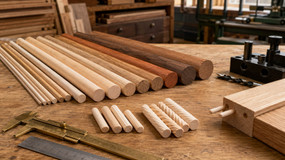
Wooden dowels are cylindrical rods or short pins used to align and join parts without metal fasteners. Continuous rods are typically sold in 36, 48, or 72 inch lengths for visible or cut-to-length uses like rungs, rails, and accents 72" Hardwood Dowels. Dowel pins are short, engineered fasteners, often fluted or spiral grooved, that let air and glue escape for reliable, hidden joints What are Wood Dowel Pins Used For?, Pre-Glued Dowel Pins.
Why correct selection prevents failure
Oversized dowels remove too much host material and invite splits. Undersized dowels lack shear capacity. Follow the 1/3 to 1/2 thickness rule for diameter to preserve wall thickness and strength A Guide to Wooden Dowel Sizes. Always leave a 2 to 3 mm glue chamber by drilling deeper than the insertion length to prevent hydraulic pressure from splitting the part 4 x 3 Tips for Dowelling.
The three-step workflow
- Define application and loads, and whether forces act in bending or shear. 2) Pick diameter and length by stock thickness and joint depth, and set hole depth with a glue chamber. 3) Choose a species that matches strength and workability needs, using hardwoods for structural joints and softer woods for crafts A Guide to Wooden Dowel Sizes.
Step 1: Identify Project Requirements and Loads
Start by naming the force type. Dowels used as closet or curtain rods act in bending over a span. Dowels buried in joinery work mostly in shear. A 1 inch hardwood dowel spanning 3 feet supports about 15 to 25 lb in bending before noticeable deflection A Guide to Wooden Dowel Sizes. The same diameter in a tight joint can exceed 1,000 lb in safe shear capacity, so shear joints can be much stronger How much weight can a 1-inch dowel hold?.
Structural vs decorative
Structural joints and load-bearing elements call for dense hardwoods and correct sizing. A single 3/8 inch oak dowel can carry hundreds of pounds in shear when properly fitted A Guide to Wooden Dowel Sizes. Decorative uses like trim or crafts can use softer woods and smaller diameters where loads are light.
Environmental and joint-type factors
For indoor furniture, dry, dimensionally accurate dowels improve reliability. Outdoor use and large temperature swings require extra design care and protective finishes, since moisture changes can affect fit and stability. Through-dowels can be sized for appearance and strength, while blind dowels rely on precise hole depth and a small glue chamber for clean assembly 4 x 3 Tips for Dowelling.
Decision framework by project
Use this quick map to connect project type to force mode and starting specs, then refine with Step 2 sizing.
| Project type | Force mode | Starting diameter | Typical species | Notes |
|---|---|---|---|---|
| Frameless cabinets | Shear | 8 mm or 5/16 in | Birch | Standard for 3/4 in panels in the 32 mm system Dowels Best for Frameless. |
| Face frames, chairs | Shear | 5/16 to 3/8 in | Maple, Oak | Dense hardwoods raise shear capacity A Guide to Wooden Dowel Sizes. |
| Workbench, 2x lumber joints | Shear | 1/2 in | Oak, Hickory | For 1.5 in stock, space 8 to 10 in apart How to Use a Dowel Jig. |
| Closet or curtain rod | Bending | Large diameter | Oak, Ash | Bending governs selection; keep spans modest A Guide to Wooden Dowel Sizes. |
Step 2: Select the Correct Dowel Diameter and Length
List your US-standard diameter options: 1/8, 3/16, 1/4, 5/16, 3/8, 1/2, 5/8, 3/4, 7/8, and 1 inch. Size the dowel to the thinner member using the 1/3 to 1/2 thickness rule to avoid thin walls and splits A Guide to Wooden Dowel Sizes. Drill holes 2 to 3 mm deeper than the insertion length to create a glue chamber that relieves hydraulic pressure 4 x 3 Tips for Dowelling.
Sizing chart by stock thickness
Use these proven pairings as a starting point, then confirm with fit and load.
| Stock thickness | Recommended diameter | Typical length | Best species |
|---|---|---|---|
| 1/2 to 5/8 in | 1/4 in | 1 to 1-1/2 in | Birch, Poplar A Guide to Wooden Dowel Sizes |
| 3/4 in | 5/16 in or 8 mm | About 1-1/2 in | Birch, Hard Maple A Guide to Wooden Dowel Sizes |
| 1 in | 3/8 in | About 2 in | Oak, Cherry, Ash A Guide to Wooden Dowel Sizes |
| 1-1/2 to 2 in | 1/2 in | 3 to 4 in | Hickory, Oak, Ash How to Use a Dowel Jig |
Fit, tolerances, and common mistakes
Quality dowels are milled within about +/- 0.015 in diameter tolerance, and bow or warp should not exceed about 1 percent of length, which keeps joints accurate and reduces assembly force Dowel Rods. Prefer metric pins for imported kits to avoid forcing imperial sizes that split parts. Avoid using a dowel larger than half the stock thickness, and do not bottom out the dowel in a blind hole. Always leave a 2 to 3 mm glue chamber A Guide to Wooden Dowel Sizes, 4 x 3 Tips for Dowelling.
Step 3: Choose the Right Wood Species for Dowels
Hardwoods offer tighter grain, higher density, and superior shear and bending strength compared to softwoods, which makes them the go-to for structural joints Which Wood Species for Your Next DIY Dowel. Oak and Maple are dense and handle heavy stress, while Birch machines cleanly and is a favorite for production. Pine and Poplar are easy to cut and shape, good for crafts and painted work but not ideal for heavy shear loads Choosing the Right Hardwood Dowel Rods.
Species comparison at a glance
| Species | Strength tendency | Workability | Best applications | Finish notes |
|---|---|---|---|---|
| Oak (Red/White) | Very high shear and bending | Machines well, open grain | Structural joints, furniture | Stains well, visible grain Choosing the Right Hardwood Dowel Rods |
| Hard Maple | Very high, fine grain | Hard, crisp machining | Chairs, face frames | Smooth, light color Which Wood Species for Your Next DIY Dowel |
| Birch | High, uniform | Excellent for pins | Cabinetry, production | Even texture, paints well Which Wood Species for Your Next DIY Dowel |
| Ash | High, good shock resistance | Machines cleanly | Rails, visible rods | Open grain, good for clear coats Choosing the Right Hardwood Dowel Rods |
| Hickory | Very high impact | Tough to machine | Heavy-duty joints, handles | Prominent grain |
| Cherry | Moderate-high | Excellent hand tools | Visible furniture accents | Rich color, finishes beautifully |
| Poplar | Moderate, softer | Easy to cut and sand | Crafts, painted parts | Paints well, muted grain |
| Pine | Moderate, soft | Very easy to shape | Light-duty crafts | Takes paint well |
For stability, premium dowels are kiln-dried to about 6 to 8 percent moisture content, which helps maintain fit after assembly Wood Dowel Rods - Moisture.
Matching Dowels to Specific Project Types
Use these field-tested starting points, then validate with the sizing rule, hole depth, and trial fits. For 3/4 inch case construction in the 32 mm system, 8 mm or 5/16 inch fluted birch pins are standard because they align well and let glue escape Dowels Best for Frameless. For 1.5 inch framing lumber in benches and beds, use 1/2 inch hardwood dowels and space 8 to 10 inches apart How to Use a Dowel Jig.
Project-ready suggestions
Cabinet carcasses and shelves: 5/16 in or 8 mm birch pins in 3/4 in panels. Use fluted pins to relieve glue pressure Dowels Best for Frameless.
Face frames and table rails: 3/8 in maple or oak where joints see racking. Dense hardwoods raise shear capacity A Guide to Wooden Dowel Sizes.
Heavy workbenches and bed rails: 1/2 in hickory or oak in 1.5 in stock, spaced 8 to 10 in How to Use a Dowel Jig.
MDF or particleboard: choose straight-flute pins that do not shred composite cores Dowel Drilling and Use Guidelines.
Visible rods and accents: select smooth hardwood rods in matching species and size for appearance 72" Hardwood Dowels.
Quality Indicators to Check Before Buying
Check three things: dimensional accuracy, straightness, and moisture content. Industry guidance puts diameter variance near +/- 0.015 in, and bow or warp near 1 percent of length or less, which keeps alignments true Dowel Rods. High-quality dowels are kiln-dried to about 6 to 8 percent moisture for stable, tight joints after glue cures Wood Dowel Rods - Moisture.
Grain, surface, and pin style
Prefer straight, continuous grain without runout in critical joints. Surfaces should be smooth and free of checks or knots for predictable strength. Fluted pins are the industry standard to let glue and air escape, while spiral pins increase glue area and can deliver repeatable fits in CNC-bored holes Spiral Versus Fluted Dowels.
What affects dowel pricing?
Several factors influence the cost of wooden dowels:
- Wood species: Dense hardwoods like oak, maple, and hickory are more difficult to source and machine than softwoods or poplar, which can increase the price due to their superior strength and durability.
- Manufacturing tolerances: Dowels milled to tighter diameter tolerances and with minimal bow or warp require more precise equipment and quality control, which adds to production costs.
- Moisture control: Kiln-drying dowels to a moisture content of 6 to 8 percent helps ensure long-term stability, but this extra processing step also impacts the final price.
- Grain and appearance: Premium dowels are selected for straight, continuous grain and minimal knots or defects, which can mean higher material waste and higher cost per usable piece.
- Special features: Fluted or spiral-grooved pins, as well as pre-glued options, involve additional manufacturing steps and materials, affecting the overall price.
By understanding these aspects, you can see why dowel prices vary and what you are getting in terms of performance and reliability.
Working With Dowels for Reliable Results
Store dowels indoors so they remain dimensionally stable. Cut rods with a fine-tooth blade and support the exit to reduce splintering. Bore holes with a quality brad-point bit or guided system so holes stay perpendicular and aligned. Use a jig or dowel centers to keep layouts accurate How to Use a Dowel Jig.
Drilling, gluing, and spacing
Keep the distance from a dowel hole to the panel edge at least equal to the dowel radius for strength. Drill each hole 2 to 3 mm deeper than the insertion length to form a glue chamber Dowel Drilling and Use Guidelines, 4 x 3 Tips for Dowelling. Apply glue to the hole walls and the pin. For pre-glued pins, mist lightly with water to activate adhesive and reduce squeeze-out Pre-Glued Dowel Pins. For 1.5 inch stock, space pins 8 to 10 inches apart; use closer spacing in thinner stock as needed How to Use a Dowel Jig.
Troubleshooting
- Loose joint: check dowel diameter tolerance and hole size, and verify dowel moisture is near 6 to 8 percent Wood Dowel Rods - Moisture, Dowel Rods.
- Splitting on assembly: reduce diameter to respect the 1/3 to 1/2 rule, and ensure a 2 to 3 mm glue chamber A Guide to Wooden Dowel Sizes, 4 x 3 Tips for Dowelling.
- Misalignment: use a jig or horizontal borer for consistent, perpendicular holes How to Use a Dowel Jig.
Dowel Selection Quick Reference Chart
Use this chart to pair stock thickness with starting diameters, lengths, and species. Confirm with the 1/3 to 1/2 rule and test fits.
| Application/Stock | Recommended diameter | Suggested length | Best species | Typical uses |
|---|---|---|---|---|
| 1/2 to 5/8 in stock | 1/4 in | 1 to 1-1/2 in | Birch, Poplar | Drawers, light crafts A Guide to Wooden Dowel Sizes |
| 3/4 in panels | 5/16 in or 8 mm | About 1-1/2 in | Birch, Hard Maple | Frameless cabinetry, case goods Dowels Best for Frameless |
| 1 in members | 3/8 in | About 2 in | Oak, Cherry, Ash | Face frames, standard furniture A Guide to Wooden Dowel Sizes |
| 1.5 to 2 in members | 1/2 in | 3 to 4 in | Hickory, Oak, Ash | 2x framing joints, workbenches How to Use a Dowel Jig |
Quick flow for fast picks: 1) Identify force type: bending or shear. 2) Measure thinnest member. 3) Choose diameter at 1/3 to 1/2 of that thickness. 4) Drill hole slightly deeper than the insertion by 2 to 3 mm to form a glue chamber. 5) Select a hardwood for structural joints or a softer wood for crafts A Guide to Wooden Dowel Sizes, 4 x 3 Tips for Dowelling.
Frequently Asked Questions About Dowel Selection
Here are concise answers to common dowel selection questions, with links where data is available.
Can I use a larger diameter dowel than recommended?
Avoid it. Exceeding 50 percent of the board thickness removes too much host material and raises the risk of splitting under stress A Guide to Wooden Dowel Sizes.
What's the difference between dowel rods and dowel pins?
Rods are long, smooth lengths, usually 36 to 72 inches, often visible or cut to length. Pins are short, engineered fasteners with flutes or spirals for glue escape in hidden joints What are Wood Dowel Pins Used For?, 72" Hardwood Dowels.
How do I know if my dowels are dry enough?
Premium dowels are kiln-dried to about 6 to 8 percent moisture. Too-wet dowels shrink later and loosen joints Wood Dowel Rods - Moisture.
What's the strongest wood for dowels?
High-density hardwoods like Hickory, Oak, Ash, and Hard Maple provide top shear performance for load-bearing joints Choosing the Right Hardwood Dowel Rods.
How much weight can a dowel support?
Orientation drives capacity. A 1 inch hardwood dowel over 3 feet in bending supports about 15 to 25 lb, while in a tight shear joint it can exceed 1,000 lb A Guide to Wooden Dowel Sizes, How much weight can a 1-inch dowel hold?.
Why are some dowels more expensive?
The cost of dowels is affected by several factors, not just the species of wood. Dowels made from premium hardwoods, milled to tight tolerances, kiln-dried for moisture stability, and selected for straight grain and minimal defects all require more resources and quality control. Additional features like fluting, spiral grooves, or pre-applied glue also add to production complexity. These factors contribute to higher pricing for dowels that deliver superior fit, strength, and reliability Dowel Rods, Wood Dowel Rods - Moisture.
Where to Buy Quality Wooden Dowels: What Total Wood Store Offers
TotalWoodStore.com , the e-commerce arm of Capitol City Lumber Company in Raleigh, NC, has supplied quality wood products since 1947. Shop solid hardwood dowel rods in standard lengths of 36, 48, and 72 inches, and a broad diameter range from 1/4 inch up to 2 inches 72" Hardwood Dowels, 36" Hardwood Dowels.
Species, sizing, and custom options
Choose Hickory, Ash, Hard Maple, Cherry, Walnut, Poplar, Red Oak, or White Oak to match strength and appearance needs 72" Hardwood Dowels, 36" Hardwood Dowels. Need square stock for legs or balusters? Order 2x2 or 3x3 square hardwood dowels in long lengths for custom builds 2x2 Square Hardwood Dowel, 3x3 Square Hardwood Dowel. Clear product specs and careful milling help you select the right piece quickly.
Conclusion
Choose dowels by force type, geometry, and species. Use the 1/3 to 1/2 diameter rule for stock thickness, drill a little deeper for a 2 to 3 mm glue chamber, and select dense hardwoods for structural joints. Verify tolerances, straightness, and moisture near 6 to 8 percent for a snug, lasting fit. When you need consistent, ready-to-finish hardwood dowels in standard sizes and premium species, shop Total Wood Store for 36, 48, and 72 inch rods in diameters from 1/4 inch to 2 inches. Explore our selection and get the right dowel to build once and build right.
References
- A Guide to Wooden Dowel Sizes
- 4 x 3 Tips for Dowelling with Wooden Dowels
- How much weight can a 1-inch x 11-inch dowel hold/support?
- Dowel Rods
- Wood Dowel Rods - Birch Oak Walnut Maple
- Dowels Best for Frameless Construction
- How to Use a Dowel Jig
- Dowel Drilling and Use Guidelines
- Spiral Versus Fluted Dowels
- What are Wood Dowel Pins Used For?
- Pre-Glued Dowel Pins
- Choosing the Right Hardwood Dowel Rods
- Which Wood Species Should You Use for Your Next DIY Dowel Project?
- 72" Hardwood Dowels in Hickory, Ash, Maple, Cherry and Oak
- 36" Hardwood Dowels in Cherry, Maple, Walnut, Oak, and Poplar
- 2x2 Square Hardwood Dowel
- 3x3 Square Hardwood Dowel