
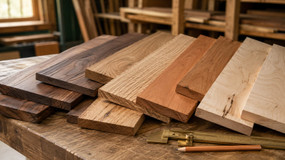
Hardwood grades are based on clear-wood yield, not looks. FAS delivers an 83-1/3% clear yield and commands top prices, while #1 Common at 66-2/3% and #2 Common at 50% cost less and can be the smarter buy for projects with smaller parts (Woodworkers Source; Bull Valley Hardwood). Prices vary widely by species and thickness, from about $3.50 per bd ft for Poplar to over $18 for Walnut in 2025–2026 (WoodworkingTraining).
Drawing on our 75+ years outfitting builders and DIYers, here are the essential guidelines for selecting hardwood. Start with the required look and service environment, then match grade to part size to avoid overpaying. FAS shines for long, visible runs. #1 or #2 Common often wins on cost when you can crosscut around defects. Use real market benchmarks and understand cost drivers like drying and tariffs to set a realistic budget (Woodworking Network; The Green Mission Inc.).
Key Takeaways
- FAS must yield 83-1/3% clear wood; #1 Common 66-2/3%; #2 Common 50% (Woodworkers Source; Bull Valley Hardwood).
- Optimizing lower grades for small parts cut material costs by 26.5% in a cabinet study (Operations Research study).
- 2025–2026 retail benchmarks: Poplar about $3.50–$5.50/bd ft, Walnut about $10.00–$18.00+ (WoodworkingTraining).
What are the main grades of hardwood lumber?
NHLA grades measure the percentage of clear, defect-free cuttings a board can yield. They are mathematical, not subjective. FAS requires a minimum clear yield of 83-1/3% and larger board sizes, while #1 and #2 Common allow more defects at lower prices (Woodworkers Source; Bull Valley Hardwood).
Core thresholds: FAS at 83-1/3% clear yield, #1 Common at 66-2/3%, and #2 Common at 50% clear yield. These rules standardize buying and selling across the US hardwood market (Woodworkers Source; Bull Valley Hardwood).
Grading references Surface Measure, calculated as width in inches times length in feet divided by 12, and the count of allowable clear cuttings. For full rule details, see the NHLA handbook overview.
Where each grade fits
FAS suits fine furniture and architectural panels where long, wide clear faces matter. #1 Common, often called cabinet grade, is ideal when parts are moderate sized. #2 Common is an economical choice for rustic looks or when ripping and crosscutting around knots still yields clean components.
What is the best grade of hardwood lumber?
FAS is the top grade for maximum clear area and the fewest defects. It is the right call for long, visible runs like table tops or door stiles (Woodworkers Source). The best economic choice, however, depends on part size.
If you are cutting small components, lower grades can win. A cabinet manufacturing study showed that optimizing lumber allocation toward lower grades cut lumber input costs by 26.5% and reduced total input volume by about 28.8% (Operations Research study). This happens because you avoid paying FAS premiums for long clear sections you will crosscut anyway.
Pro tip: match grade to part size
If your project is built from short parts, buy #1 or #2 Common and crosscut between defects. You get flawless pieces at lower cost. Reserve FAS for long rails, panels, and show faces where continuous clarity drives the design.
What are premium hardwoods?
Premium hardwoods combine species desirability, dimensional stability, and standout figure. Walnut, Cherry, Hard Maple, and select exotics like Mahogany are classic premium choices for color, workability, and long-term performance. Designers also elevate grades like Quartered and Rift White Oak for stability and straight grain (Havwoods; Vantia Hardwoods).
In flooring, Prime Grade delivers uniformity, while Character Grade embraces knots and mineral streaks for a luxury rustic look that is trending in high-end spaces (Duramagic Floor; Dyfed Richards).
Engineered premium options
Premium engineered planks pair a thick, refinishable wear layer with a stable multi-ply core. This construction improves width stability while preserving the look and service life of real hardwood, a strong option in variable humidity environments.
What is the most expensive hardwood lumber?
Globally, prices reflect rarity and specialized properties. Agarwood is reported at about $30,000 to $40,000 per board foot, driven by a unique resin used in luxury perfumery (Luxe Digital). Snakewood commonly lists around $300 to $350 per board foot, while African Blackwood often exceeds $100 per board foot, and Pink Ivory can range roughly $30 to $80 per board foot (Wooden Earth; AtoZ Wood Company).
Domestically, Oregon Myrtle is among the priciest North American hardwoods due to limited range and striking figure (Woodworking Network, Oregon Myrtle; Oregon Discovery). American Black Walnut and figured Maples also sit at the premium end, especially in higher grades and select cuts.
Use cases behind high prices
African Blackwood is prized in woodwinds for its acoustic properties. Highly figured domestic burls and quartersawn cuts command premiums where visual or stability demands are strict.
How is hardwood lumber priced in the US?
Hardwood sells by the board foot. One board foot is 144 cubic inches, calculated as width in inches times length in feet times thickness in inches divided by 12. Price depends on species, grade, thickness, and market conditions.
2025–2026 estimated retail ranges offer a useful compass: Poplar about $3.50–$5.50, Red Oak about $5.50–$9.00, White Oak about $6.50–$11.00+, Walnut about $10.00–$18.00+ per bd ft (WoodworkingTraining). Forest and sawmill operations drive about 50–70% of total cost, while kiln drying adds roughly 10–20% (Woodworking Network). Combined US duties on some Canadian imports sometimes exceeded 35% between 2024 and 2026, contributing to price volatility (The Green Mission Inc.).
Rough lumber is cheaper than S4S because surfacing shifts machining time to the seller. Paying extra for S4S can be a smart trade if you lack a jointer and planer (Jeff Mack Supply).
2025–2026 price snapshot by species
The ranges below reflect common retail estimates for FAS/Select thicknesses.
| Species | Range per bd ft |
|---|---|
| Poplar | $3.50–$5.50 |
| Red Oak | $5.50–$9.00 |
| White Oak | $6.50–$11.00+ |
| Walnut | $10.00–$18.00+ |
Source: WoodworkingTraining.
How do I choose the right hardwood for my project?
Start with function, then finish with form. Define the environment, visibility, and budget. Dense species like Hard Maple, Hickory, and White Oak resist denting for load or high-traffic use. White Oak’s closed cellular structure limits water movement compared to open-grain species, so it is a strong choice for damp areas.
Match grade to part size. Use FAS or Select for long show surfaces. For small parts, buy #1 or #2 Common and crosscut around defects. This approach mirrors a cabinet study that cut lumber costs by 26.5% through smarter allocation (Operations Research study).
Practical buying tips
- For cutting boards or simple shelves, S4S stock saves setup time if you do not own a jointer and planer (Jeff Mack Supply).
- Building 12 inch table legs from Walnut? #1 Common can yield identical parts at a fraction of FAS pricing when you crosscut between knots, while keeping the rich Walnut look.
- Prefer organic texture or industrial style. Consider Character grade to showcase knots and mineral streaks while lowering material cost (Dyfed Richards).
FAQ
Quick answers you can reference on the jobsite or in the shop.
What does FAS mean?
FAS stands for Firsts and Seconds. It targets long, wide, mostly defect-free faces. It must yield at least 83-1/3% clear wood (Woodworkers Source).
How do I calculate board feet?
Multiply width in inches by length in feet by thickness in inches, then divide by 12. One board foot equals 144 cubic inches.
Is S4S worth the premium?
Yes if you lack milling machines or need speed. You pay more per board foot but skip jointing and planing (Jeff Mack Supply).
Why is Walnut more expensive than Poplar?
Walnut is scarcer and in higher design demand. 2025–2026 ranges: Walnut about $10.00–$18.00+, Poplar about $3.50–$5.50 per bd ft (WoodworkingTraining).
Conclusion
Choosing hardwood wisely is about aligning grade, species, and thickness with your exact parts list. NHLA grades quantify clear yield, so you pay in proportion to usable wood. Many projects do not need continuous clear faces across long lengths, which is why optimized use of lower grades cut material costs by 26.5% in an industrial case (Operations Research study). Design trends favor White Oak and Walnut in both Prime and Character looks, with a visible shift to natural texture in luxury spaces (Revival Flooring). Pricing remains volatile due to cost inputs and trade policy, so verify current ranges before buying (The Green Mission Inc.). Compare species, grades, and surfacing. Total Wood Store lists dimensions and grades clearly to help you pick the right fit without overpaying.
If you want help translating drawings into a cut list and grade plan, our team at Total Wood Store can walk you through species, thickness, and surfacing options. Order online, take advantage of volume pricing, and get lumber that fits your build without paying for waste.
References
- Hardwood Lumber Grades Explained
- NHLA Grading Rules Overview
- NHLA Hardwood Lumber Grade Rules
- Lumber Cost Calculator and Benchmarks
- What makes hardwood lumber pricing
- The Lumber Market in 2026
- S4S vs Rough Lumber
- Hardwood flooring grades explained
- Understanding hardwood species, grains, and grades
- Hardwood flooring grades explained
- Prime vs Character wood grades
- The most expensive woods in the world
- Most expensive varieties of wood
- Most expensive wood in the world
- Oregon Myrtle, aka California Laurel
- Top urban hardwood flooring trends in 2026